
The app, and the family around it.
One open format, one free desktop app to live in — and a family of
services that grow out of the same plain .md file.
Every other format makes you pick one.
Files are portable but frozen. Apps respond but need a server and a login. Rho MD is the only thing that's both.
PDF, slides, video, plain Markdown. Easy to send and keep — but the bits never change when you look at them.
SaaS dashboards, notebooks, online widgets. They respond — but they live behind an install, an account, a URL that rots.
Rho MD lives here. A single declarative .md that computes for the reader — and still emails, greps, and stores for ten years.
Where Rho shines.
Interactivity wins decisively whenever the content has variables, cause-and-effect, or steps. These are the documents Rho was built for.
Don't explain the formula — let them feel it.
Drag-to-learn explorables for math, finance literacy, physics, statistics. The reader builds intuition by manipulating, not watching.
What-if, not just what-is.
Readers plug in their own assumptions and the report recomputes for them — projections, models, pricing, scenarios. One file, every scenario.
Docs that demonstrate.
Live config builders, tunable API examples, step-through guides, and version timelines — the doc shows the behavior instead of describing it.
A dashboard you can email.
Metrics and charts that compute locally — no BI login, no broken link next quarter. Send the numbers and the controls in one .md.
More than a reader.
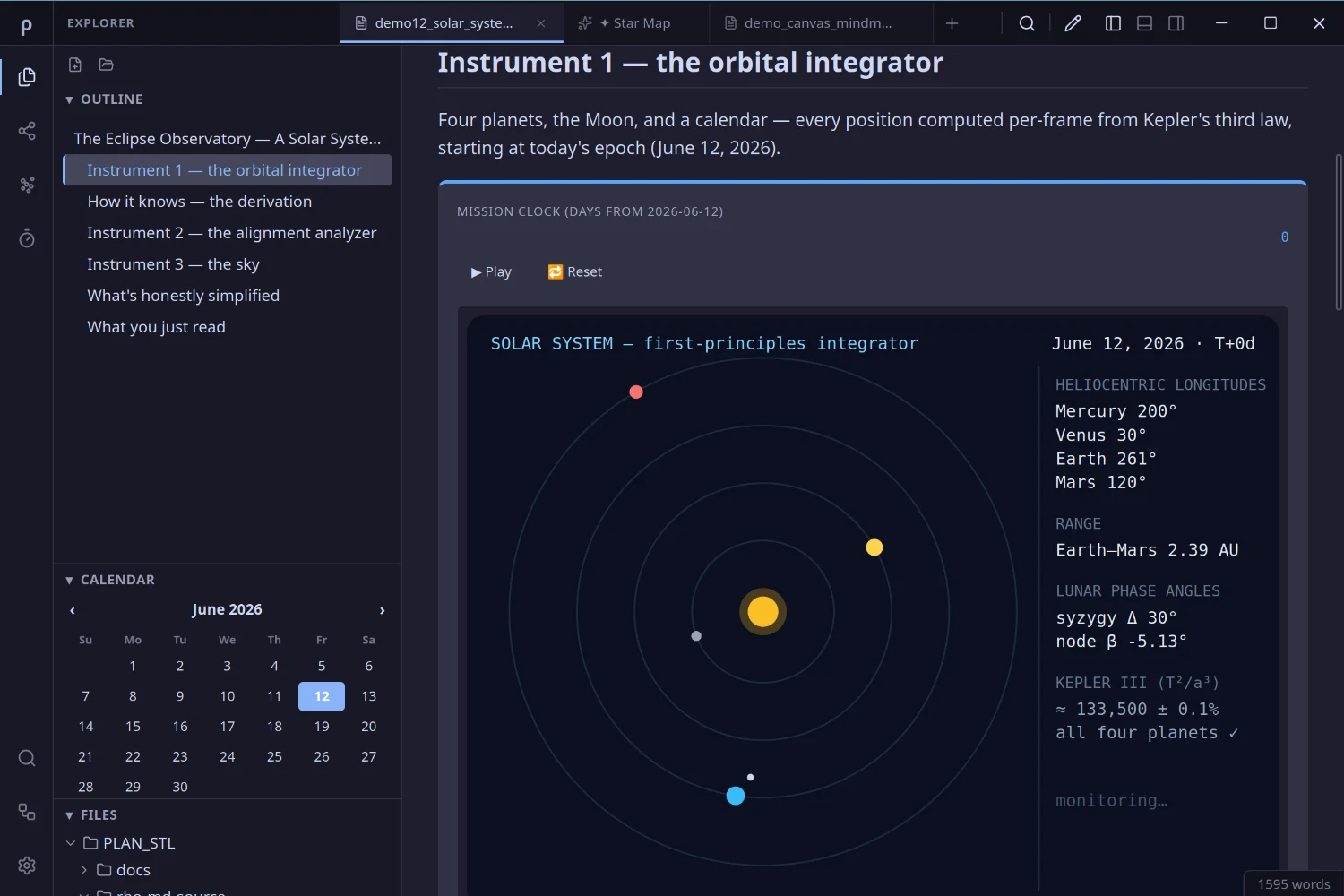
The free desktop app is where your library lives — edit in place,
organize visually, lock what's private. All of it stays plain
.md on your disk.
.md file.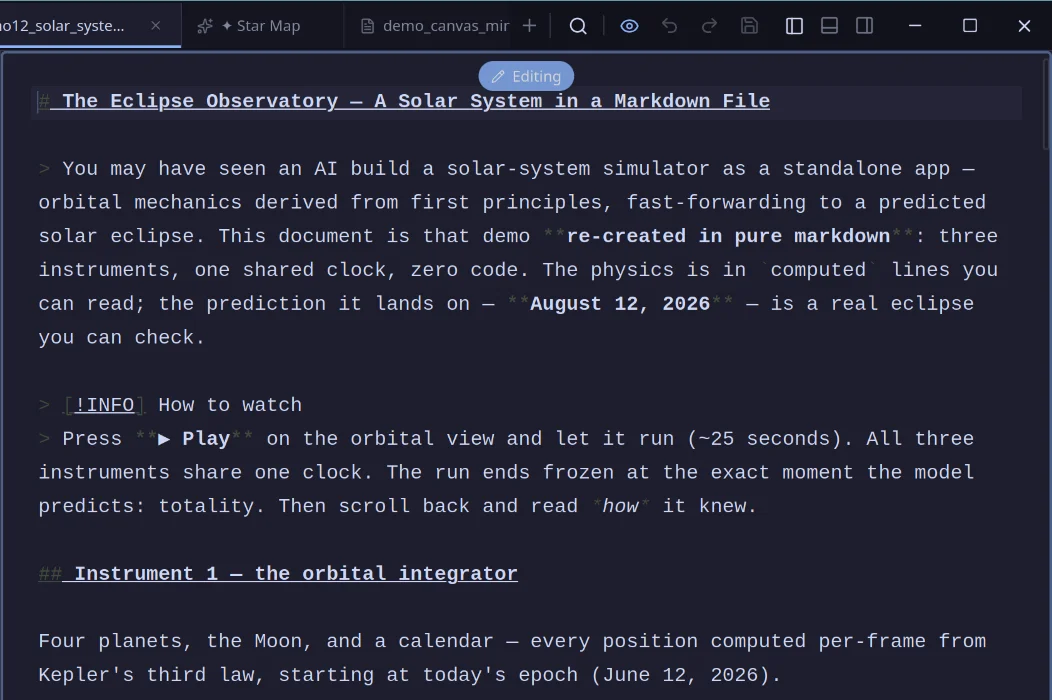
Edit in place
WYSIWYG-lite editing for your text, with a slider down to raw Markdown when you want the source. Common syntax converts as you type.

A star map of your library
Psi, the built-in document manager, lays your docs out as a galaxy — related documents cluster together. Double-click a star to open it.
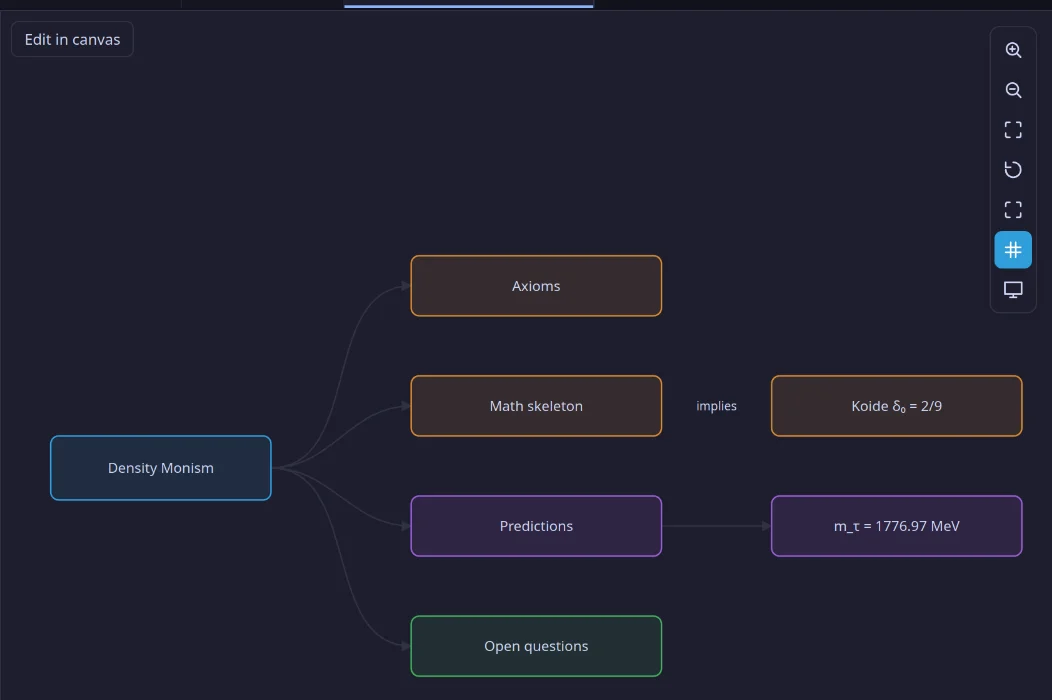
A freeform canvas
Think on an infinite board — drag notes, link ideas, drop in documents. It saves as a plain .md file, like everything else.
Lock what's private
Password-protect any document: encrypt it so reading needs the password, or keep it readable and require the password only to edit.
Plugins, done right
A clean plugin API — with official calendar and pomodoro plugins — built on the same registry the app's own features use.
AI-native to the core
Every command — open, edit, organize, lock, publish — is exposed through a local agent API. Your AI assistant can drive the whole app.
One format. A family of ways to use it.
Reading and sharing are free — that's how Rho spreads. Syncing, publishing, and hosted AI are where Rho earns its keep.
The app: read, write and organize Markdown, time your work and ask Rho AI — on desktop and Android.
rho.md/download.html →Store and share privately for free — you name who can open each document. $5/mo keeps every device in sync, and publishes to the public index with search and your author page.
rho.md/cloud →Describe what you want in plain language; get back a working interactive .md. Ten requests free on any account; every paid plan includes it, from $5/mo — the model is run by us, no API key to set up.
Questions, answered.
Is it really just a file?
Yes. A Rho document is a plain .md file — open it in any text editor and you'll see normal Markdown with a few fenced blocks. There's no proprietary container, no database row. The file is the document.
Do my readers need an account or an install?
An account, no — reading in Rho MD is free and never asks for one. (A private link is the one exception: the people you name sign in, free, so the document knows it really is them.) An install, yes — Rho MD is a free download, out now for Windows, macOS, Linux and Android.
Is the format actually open?
Yes. Rho speaks AINP, published under CC BY 4.0. Anyone can read the spec, write documents, or build their own reader. The format isn't ours to lock — that's the point.
How is this different from Notion or Google Docs?
Those live on a server behind a login — your document isn't a portable file you can email, grep, or keep for a decade. Rho is a file first: it works offline, travels anywhere, and still computes for the reader.
How is it different from a PDF?
Same portability — one file you can send and archive — but a PDF is frozen. Rho documents respond: drag a slider, switch a tab, step through a process, and the page recalculates for you.
Is my data private?
The file stays with you. Rendering never loads network content — that's enforced structurally, not just promised — so opening a Rho document can't phone home. The app itself is just as quiet: no analytics, no identifiers, no automatic crash reporting. Its only unprompted request is the update check — three values (version, OS, architecture), with no request log kept, counted only as anonymous daily totals. And for documents that are nobody's business, you can password-protect them: encrypted to read, or open to read but locked to edit.
Can my AI assistant use the app?
Yes — by design. The desktop app exposes every command through a local agent API: an assistant can open documents, edit them, organize the library, and publish, using the same commands you do. Rho MD is built to be driven by AI, not just to render what AI writes.